

Everything you ever said, kept.
SMS and iMessage, calls, WhatsApp, Viber, Telegram, Signal, Messenger, and the messengers of the 2000s: one archive, on your own computer, that does not forget when a phone does.
try it on invented people: everysaid demo --serve
brb, someone needs the phone line
Πάμε για καφέ;
Landed! Call you tomorrow
Found it: that message from 2009, still here.
- SMS
- MMS
- iMessage
- RCS
- Phone
- FaceTime
- Viber
- Telegram
- Signal
- Messenger
- SIP
- MSN
- ICQ
- AIM
- Yahoo
- Jabber
- Google Talk
- Skype
- IRC
A messenger for your whole history
Every conversation with someone, whatever service it was on, as one chat. On the desktop and on the phone, where it installs as an app with notifications.

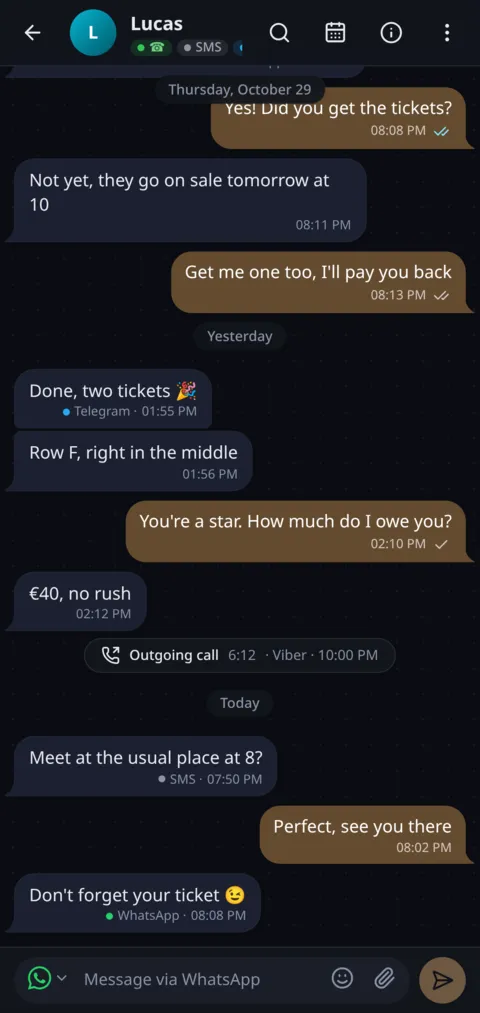
Gathered
From the phones, from the services, and from the logs of long ago.
- Encrypted iPhone backups, read on Linux
- Android's calls, SMS and MMS, over adb
- Telegram, WhatsApp and Signal, as a linked device
- Messenger and Instagram, from Meta's export
- Adium and Pidgin logs: MSN, ICQ, AIM, Yahoo
Kept once
Every message and call once, whichever phone or service it came from.
- Deduplicated across phones and sources
- Replies, reactions, edits, locations, missed calls
- One person across all their numbers and accounts
- Only ever added to: nothing goes when a phone drops it
Live
Answer from the same place you read, on any service that allows it.
- New messages arrive as they come
- Send, reply, react, edit, forward
- Search that ignores accents: καφε finds καφέ
- People, calls, media and statistics
On your own computer
The archive is one SQLite database in your own folder. Nothing goes through iCloud, or through anyone's cloud.
Phones are never written to
Their history is read from an encrypted backup or with adb queries. Nothing is ever put back on a phone.
Outlives the phone
A message stays in the archive after the phone that held it is gone, wiped or replaced.
Built to be reached
Passkeys, or a password with an authenticator app. The services' keys live in the system keyring and an encrypted store.
Models stay at home
Names for people without one can be suggested by models running on your own computer, through Ollama. Nothing is sent out.
One program, AGPL
A single Go binary for Linux, macOS and Windows, free software under the GNU AGPL v3. Some sources need Linux.
Ask your own history
Everysaid includes an MCP server. An assistant reads the same archive as the app: on your machine, or from elsewhere with a token you can revoke at any time.
When did I last speak with Eleni, and what about?
Yesterday evening, on Viber: she asked if you were free for coffee. Before that, a four-minute call on the 28th, and in September a long WhatsApp thread about the trip.
It can search messages, read chats, see a message in its context, find people, list calls, lay out a single day, count, and find the files of a chat. Its few changes (a name, a note, a picture for your photo library) are meant only with your approval; it can send nothing to anyone but your own notes; and a switch in the settings closes its access at once.
- search_messages
- read_chat
- message_context
- find_people
- last_interaction
- list_calls
- day_timeline
- statistics
- find_media
Meet it with invented people
The demo builds an archive of invented people, groups, calls and pictures in a folder of its own, never touching yours, and opens it in the browser.